

 Admin
Admin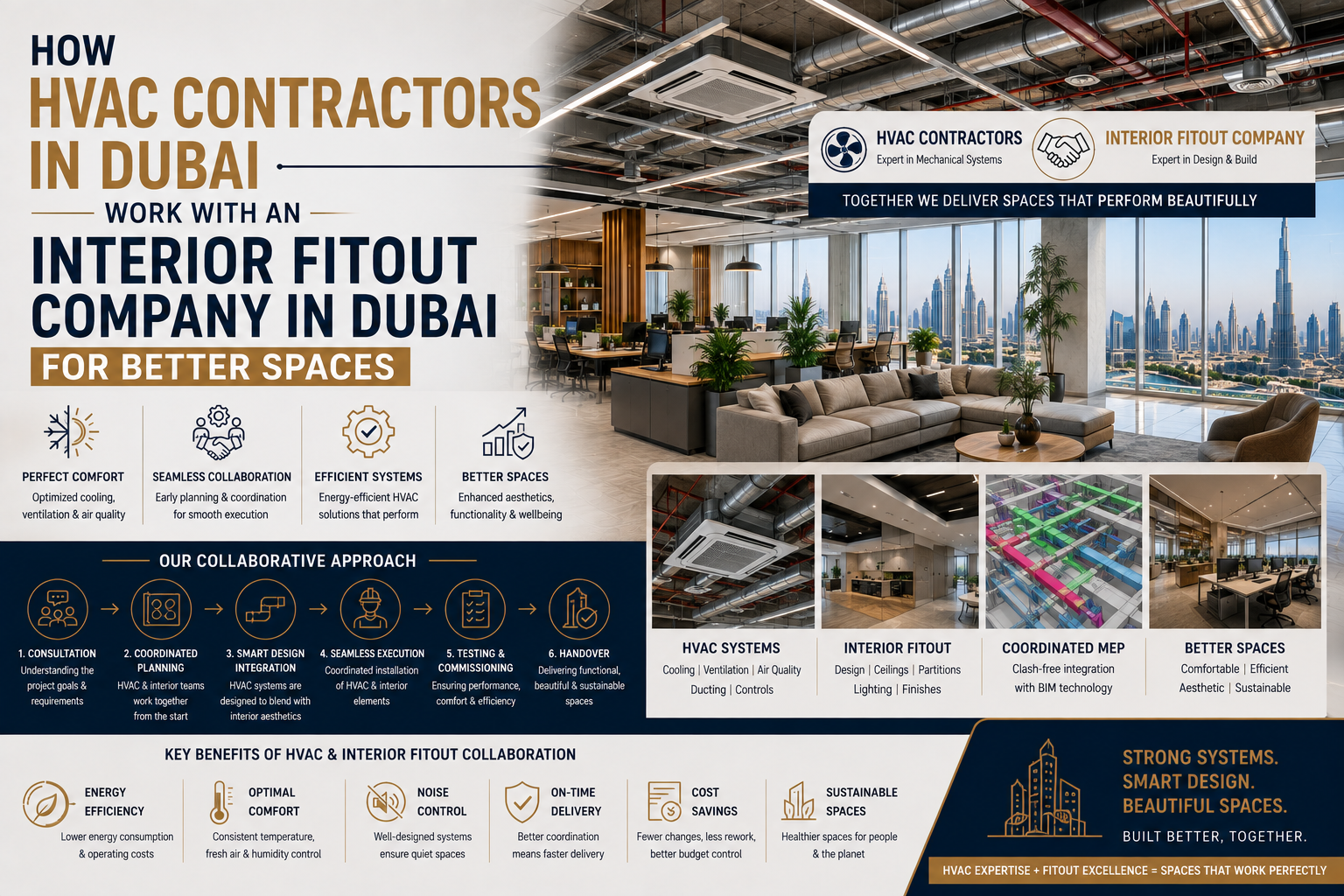
Introduction
Creating a comfortable and visually appealing commercial interior requires more than selecting the right furniture, colors, and finishes. Behind every successful workspace is a network of technical systems that supports the people using the space. Heating, ventilation, and air conditioning are particularly important in Dubai, where indoor climate control is a fundamental part of everyday building operations.
For this reason, HVAC Contractors in Dubai often need to work closely with an interior fitout company in Dubai during renovation and construction projects. When both teams coordinate from the planning stage, technical requirements can be integrated without compromising the appearance or functionality of the finished space.
Why HVAC and Interior Fitout Need to Work Together
HVAC systems can directly influence interior layouts. Ductwork, diffusers, grilles, pipes, thermostats, and access panels all require appropriate locations within ceilings and walls.
If HVAC requirements are considered only after the interior design has been finalized, changes may become necessary. These adjustments can affect ceiling designs, lighting positions, partition layouts, and even usable floor space.
Early collaboration allows designers and technical teams to identify these requirements before construction progresses too far. The result can be a cleaner appearance and a more efficient installation process.
For commercial offices, retail outlets, restaurants, clinics, and hospitality spaces, this coordination can be especially valuable because both customer experience and operational efficiency matter.
How HVAC Contractors in Dubai Support Interior Projects
Professional HVAC Contractors in Dubai are responsible for designing, installing, testing, and maintaining systems that regulate indoor temperature and air quality.
Their work may include load calculations, equipment selection, ductwork, ventilation systems, chilled-water or other cooling arrangements, thermostatic controls, and commissioning.
During an interior fitout, HVAC specialists also need to coordinate their work with other trades. Electrical installations, ceiling systems, lighting, fire safety components, and plumbing may all occupy the same areas.
A qualified hvac company in dubai therefore needs to consider the wider project rather than treating the HVAC installation as an isolated task.
The Role of an Interior Fitout Company in Dubai
An interior fitout company in Dubai focuses on transforming an empty, unfinished, or existing space into a functional interior. Its responsibilities may include space planning, partitions, ceilings, flooring, lighting, joinery, painting, and coordination of technical services.
The fitout team needs to understand where HVAC components will be positioned so that the interior design accommodates them naturally.
For example, ceiling-mounted air diffusers can be coordinated with lighting layouts, while access panels can be positioned discreetly without making maintenance difficult.
RG Interiors operates within this integrated project environment, where architectural design and building services need to work together to achieve a practical final result.
Benefits of Coordinated HVAC and Fitout Planning
The first benefit is better indoor comfort. Properly planned HVAC systems can distribute conditioned air more effectively and support consistent temperatures across different areas.
Coordination can also improve visual quality. When vents, grilles, ducts, and access points are incorporated into the design from the beginning, they can be positioned more discreetly.
Another benefit is better project scheduling. HVAC installations can be planned around ceiling, electrical, partition, and finishing activities, reducing the possibility of trades interfering with one another.
Energy efficiency is also becoming increasingly important. Correct equipment sizing, zoning, efficient controls, and appropriate insulation can contribute to more responsible building operation.
Modern Trends in HVAC and Interior Design
Technology is changing how HVAC systems interact with modern interiors. Smart thermostats, automated controls, occupancy-based systems, and zoning solutions can provide greater control over indoor conditions.
Energy-conscious design is another growing priority. Businesses are increasingly considering systems that can reduce unnecessary energy consumption while maintaining suitable comfort levels.
Concealed and aesthetically integrated HVAC components are also becoming more common in contemporary interiors. The objective is to maintain effective airflow without allowing technical equipment to dominate the visual character of the space.
A capable hvac company in dubai can work with designers and fitout specialists to determine which technologies are appropriate for each project.
Conclusion
The relationship between HVAC systems and interior design is closer than it may initially appear. HVAC Contractors in Dubai provide the technical infrastructure needed for indoor comfort, while an interior fitout company in Dubai ensures that these systems integrate effectively with the overall space.
Early collaboration can support better comfort, cleaner aesthetics, smoother scheduling, easier maintenance, and improved energy performance. Companies such as RG Interiors work within this interconnected environment, where successful projects depend on coordinating multiple technical and design requirements.
For businesses planning an office, retail, hospitality, or commercial renovation, involving an experienced hvac company in dubai and fitout team from the early planning stages can help create a space that performs well while maintaining a polished and functional interior.